📑 Table of Contents
- →1. Padel Mold Geometry Chart: Round vs. Teardrop vs. Diamond (255–278mm Balance)
- →2. Balance Point Physics, Bridge Heart Geometry & Anti-Torsion Elbow Protection
- →3. 5-Axis CNC Hole Drilling Layouts (52–68 Holes) & 3D Spin Surface Pairing
- →4. OEM Mold Portfolio Strategy: 45/35/20 Launch Ratio & Open vs. Custom Tooling
1. Padel Mold Geometry Chart: Round vs. Teardrop vs. Diamond (255–278mm Balance)
A padel racket's perimeter mold shape directly dictates its longitudinal balance point (255–278mm measured from the butt cap), effective sweet-spot surface area (110–195 cm²), and rotational swing weight within the International Padel Federation (FIP) 455mm × 260mm × 38mm rulebook envelope. Round molds anchor balance low at 255–262mm with a forgiving central 175–195 cm² sweet spot for defensive control; Teardrop molds position balance at 263–268mm (145–165 cm² upper-mid sweet spot) for two-way versatility; and Diamond molds shift balance to 270–278mm (110–128 cm² high sweet spot) to maximize overhead smash leverage.
Key Takeaways for Padel Players, Academies & OEM Buyers:
- Round Control Geometry (255–262mm Balance): Concentrates mass near the grip and bridge throat, creating a symmetrical 175–195 cm² central sweet spot that minimizes wrist torque on fast net blocks and defensive glass rebounds (CC-PD-01, CC-PD-04, CC-PD-05).
- Teardrop & Hybrid All-Court Molds (263–271mm Balance): Elevates the widest head chord above the equator (135–165 cm² sweet spot), balancing defensive lob depth with crisp bandeja speed—accounting for 45% of commercial B2B catalog volume (FC-PD-01, CC-PD-08, CC-PD-09, CC-PD-11).
- Diamond Power Leverage (270–278mm Balance): Concentrates perimeter carbon mass near the 11-to-1 o'clock tip arc (292–312 kg·cm² swing weight) to maximize ball exit velocity on x3/x4 smashes for left-side attackers (CC-PD-10, CC-PD-12).
- Ultralight (340–355g) & Junior Development Molds: Lighter adult molds (CC-PD-06) and compact 385–410mm junior/trainer geometries (CC-PD-02, CC-PD-03, CC-PD-13) lower swing weight below 254 kg·cm² for youth academies and elbow-sensitive players.
| Mold Archetype | Balance Point | Sweet-Spot Zone & Area | Swing Weight | Target Player Profile | FIP Profile Spec | RacketOEM SKUs |
|---|---|---|---|---|---|---|
| Round Control | 255 – 260 mm | Geometric center (175 – 190 cm²) | 255 – 268 kg·cm² | Right-side (drive) tacticians, counter-punchers | 38 mm (≤455 × 260 mm) | CC-PD-01, CC-PD-05 |
| Oversize Round Academy | 258 – 262 mm | Expanded center (185 – 195 cm²) | 262 – 272 kg·cm² | Beginners, club rental fleets, forgiving defense | 38 mm (≤455 × 260 mm) | CC-PD-04, CC-PD-07 |
| Classic Teardrop All-Round | 263 – 268 mm | Slightly above center (150 – 165 cm²) | 272 – 284 kg·cm² | Intermediate to advanced all-court players | 38 mm (≤455 × 258 mm) | FC-PD-01, CC-PD-09 |
| Hybrid Teardrop-Diamond Pro | 267 – 271 mm | Upper-mid percussion (135 – 148 cm²) | 282 – 294 kg·cm² | Tournament players blending bandeja & flat punch | 38 mm (≤455 × 258 mm) | CC-PD-08, CC-PD-11 |
| High-Balance Diamond Power | 270 – 278 mm | High 12-o'clock zone (110 – 128 cm²) | 292 – 312 kg·cm² | Left-side (revés) finishers & x3/x4 smashers | 38 mm (≤455 × 255 mm) | CC-PD-10, CC-PD-12 |
| Junior / Light 340–355g Mold | 250 – 260 mm (Light) / 220 – 230 mm (Youth) | Central ergonomic zone (155 – 175 cm²) | 230 – 254 kg·cm² | Junior academies, female & elbow-care lines | 38 mm Adult / 16–20 mm Youth | CC-PD-06, CC-PD-02, CC-PD-03, CC-PD-13 |
2. Balance Point Physics, Bridge Heart Geometry & Anti-Torsion Elbow Protection
Static scale weight (355–375g) never tells the complete biomechanical story: shifting the balance point upward by just 10mm—from a 260mm Round mold to a 270mm Diamond mold at identical 365g static mass—increases dynamic swing weight by 18–24 kg·cm² and amplifies forearm supination torque on off-center volleys. To prevent lateral epicondylitis (padel elbow) without sacrificing frame crispness, our engineering team pairs twin-tube perimeter carbon rails with three distinct bridge heart (throat) architectures:
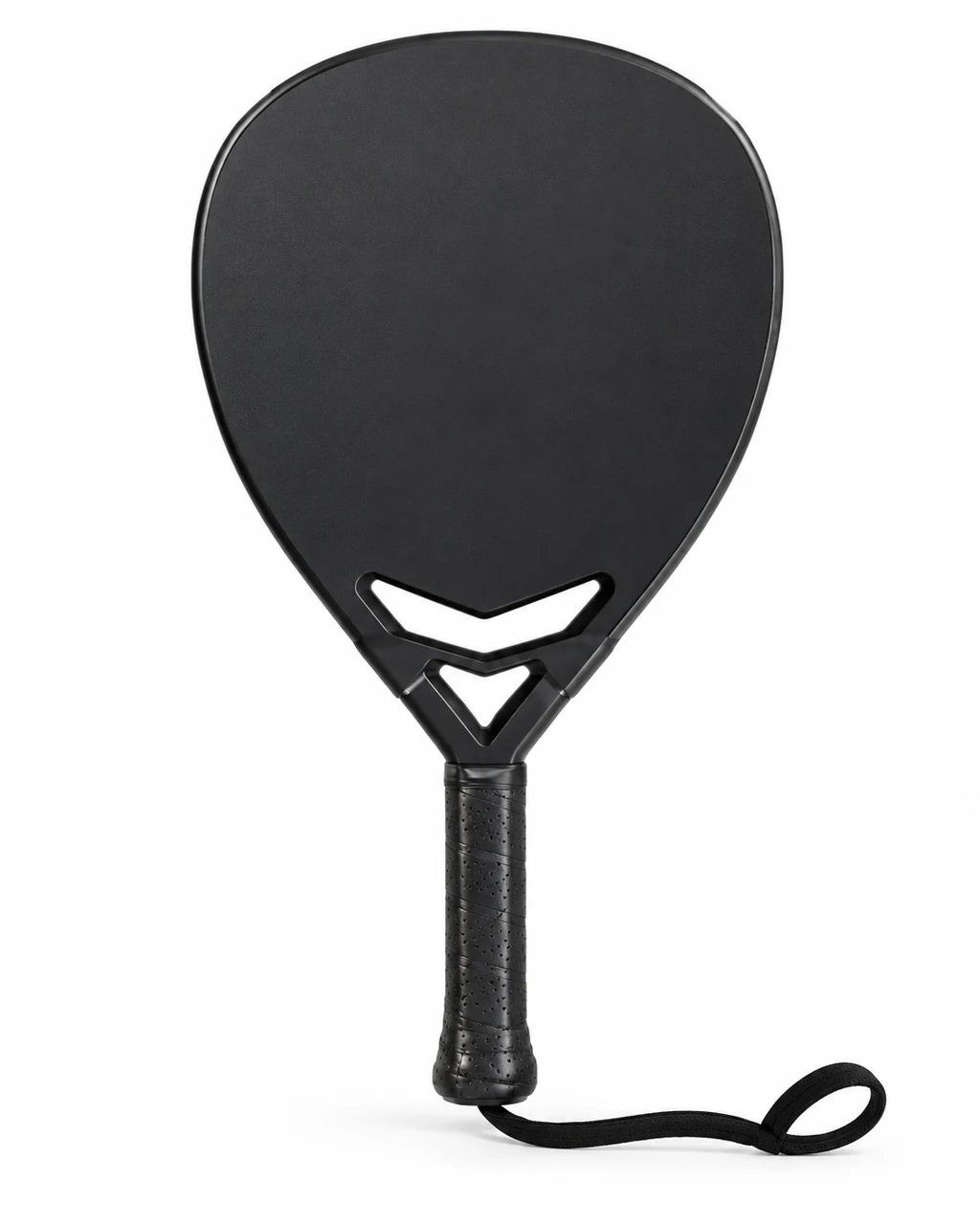
- Single-Strut Vertical Bridge Window: Splits the throat opening symmetrically to bleed turbulent air during rapid reflex volleys at the net while channeling longitudinal impact shock away from the handle shaft (featured on CC-PD-01 and CC-PD-06).
- Dual Asymmetric V-Bridge & X-Braced Throat: Triangulates shear loads between the twin-tube carbon perimeter and the PU-molded octagonal grip, reducing torsional face twist by 22%–28% when blocking heavy drives outside the sweet spot (FC-PD-01, CC-PD-04, CC-PD-08).
- Closed / Semi-Closed Anti-Vibration Heart: Adds structural damping ribs or elastomeric throat inserts inside high-balance (270–278mm) Diamond molds (CC-PD-10, CC-PD-11) to attenuate 120–250 Hz post-impact frame oscillations before they reach the elbow.
4-Step Factory Mass & Balance Calibration SOP (±3g Mass / ±2.5mm Balance)
- Step 1 — Twin-Tube Prepreg & Mandrel Weight Pairing: Bidirectional perimeter carbon tubes and internal bladder mandrels are weighed to ±1.5g tolerance prior to layup so left-to-right lateral inertia stays symmetrical.
- Step 2 — Post-Mold Laser Balance Fulcrum Check: Immediately after hot-press demolding and flash sanding, bare frames are audited on a digital fulcrum scale referenced 0mm from the butt-cap plane to verify raw mold geometry.
- Step 3 — Handle PU Density & Butt-Cap Counterweight Tuning: Molded handle foam density and non-structural butt-cap ballast fine-tune final balance within ±2.5mm of target specification without pushing total weight outside the 355–375g bin.
- Step 4 — Optical Swing-Weight Pendulum & ±3g Barcode Binning: Every finished racket undergoes dynamic pendulum swing-weight verification (kg·cm²) and electronic sorting into tight 5g retail weight bands before grip shrink-sealing.
3. 5-Axis CNC Hole Drilling Layouts (52–68 Holes) & 3D Spin Surface Pairing
Under FIP technical rules, circular perforations (9mm–13mm diameter across the central hitting zone) control aerodynamic drag, local face membrane trampoline, and effective sweet-spot diameter. Rather than stamping identical hole grids onto every racket, 5-axis CNC drilling programs must align hole density (52–68 holes) and 3D rough spin coatings directly with Round, Teardrop, or Diamond percussion coordinates:
- Concentric Multi-Diameter Matrix (11.5–13mm Outer / 10–11mm Inner, 60–68 Holes): Applied to Round and Oversize Round molds (CC-PD-01, CC-PD-04, CC-PD-07); larger outer-ring perforations soften perimeter stiffness to expand the forgiving sweet spot toward the twin-tube rail, while smaller central holes preserve core rebound.
- Curved Aerodynamic Arc with Solid Impact Center (52–58 Holes): Engineered for Teardrop and Diamond molds (FC-PD-01, CC-PD-08, CC-PD-10); leaving an unperforated 45–55mm solid composite zone directly across the upper sweet spot prevents premature resin micro-cracking and maximizes flat smash velocity.
- In-Mold 3D Peel-Ply Relief vs. Quartz Silica Sandblast Texture: Mold-cured 3D geometric relief (0.18–0.25mm tactile height) provides permanent, abrasion-resistant topspin bite for club and all-round Teardrop models, whereas micro-graded quartz silica sandblasting maximizes slice friction on pro Diamond víbora and chiquita shots.
Engineering Note on 5-Axis CNC Chamfering & Crack Prevention:
All RacketOEM padel faces are drilled post-cure at 18,000 RPM using diamond-coated carbide chamfer bits while maintaining ≥14mm inter-hole web spacing and ≥28mm clearance from the bridge throat—eliminating fiber fraying and hole-to-hole fatigue cracks.
4. OEM Mold Portfolio Strategy: 45/35/20 Launch Ratio & Open vs. Custom Tooling
When private-label padel brands, multi-court club operators, and regional distributors plan a 3-SKU or 6-SKU collection, commercial sell-through across European, Middle Eastern, Latin American, and APAC pro shops consistently favors a 45% Teardrop + 35% Round + 20% Diamond inventory split. Over-allocating initial stock into extreme 275mm+ Diamond molds narrows the addressable buyer pool and elevates beginner return rates.
- Commercial 45% / 35% / 20% Catalog Allocation: Dedicate 45% of launch volume to a versatile Teardrop flagship (FC-PD-01 or CC-PD-09, 263–268mm, 360–366g), 35% to an accessible Round control or ultralight SKU (CC-PD-01 or CC-PD-06, 255–260mm, 345–360g), and 20% to a halo Pro Diamond attacker (CC-PD-08 or CC-PD-10, 270–276mm).
- Zero-Tooling Open-Mold Program (MOQ 50–100 pcs): Select from our 14 FIP-compliant open molds (FC-PD-01 and CC-PD-01 through CC-PD-13) starting at 100 pcs per mold (split across 2 colorways of 50 pcs), with full customization of water decals, CNC hole layout, 3D/sand texture, butt-cap badge, and safety wrist cord in 25–35 days.
- Proprietary 3D CNC Cavity Tooling (FIP ≤455 × 260 × 38mm): Brands developing an exclusive bridge heart window, sculpted aerodynamic rail, or signature hybrid silhouette submit STEP/IGES CAD files for precision 5-axis CNC aluminum/steel mold machining (20–25 days tooling + T1 sample validation).
Pre-Shipment FIP Dimensional & Safety Cord Compliance:
Every open-mold and custom-tooled batch undergoes go/no-go gauge verification for total length (≤455mm), frame width (≤260mm), profile thickness (38.0mm ±0.4mm), and 180 kgf tensile testing on replaceable wrist tethers prior to export carton sealing.
Multi-Sport Racket OEM Manufacturing Matrix (39 Active Platforms)
Manufactured at our 12,000 m² facility in Fuyang District, Hangzhou (Hangzhou Bailian Trading Co., Ltd., ISO 9001:2015, Est. 2011; 1,200,000+ rackets annual capacity, 100,000+ monthly), our 39 OEM racket platforms span four court sports—Badminton (15 models), Padel (14 models), Tennis (4 models), and Squash (6 models)—engineered across Full Carbon, Carbon Composite, Aluminum Alloy, and Steel constructions.
| Sport Category | Active Models | Material & Layup Systems | Core Physical & Structural Parameters | Representative Model Codes |
|---|---|---|---|---|
| Badminton racket → | 15 | 24T/30T/40T Toray High-Modulus Carbon Prepreg (FC), Carbon Composite (CC), Aluminum Alloy (AL), Steel (ST) | Weight 3U/4U/5U (75g–98g); Balance Point 285–305mm; Shaft Ø 6.8–7.0mm; String Tension 20–35 LBS | FC-BD-01, FC-BD-02, FC-BD-03, CC-BD-01, AL-BD-01, ST-BD-01 |
| Padel racket → | 14 | 3K / 12K / 18K Woven Full Carbon (FC) & Carbon/Fiberglass Composite (CC) + EVA Memory Core | Profile 38mm standard; Weight 360±10g; Length 455mm; Balance Point 260–270mm; EVA Hardness 13°–17° | FC-PD-01, CC-PD-01, CC-PD-02, CC-PD-04, CC-PD-08, CC-PD-13 |
| Tennis racket → | 4 | T700 Full Carbon Monocoque (FC), Carbon Composite (CC), Aluminum Alloy (AL), Steel (ST) | Head Size 96–105 sq.in.; String Pattern 16×19; String Tension 52–62 LBS; Length 685mm (27 in) | UN-TN-01, UN-TN-02, UN-TN-03, UN-TN-04 |
| Squash racket → | 6 | High-Modulus Full Carbon (FC), Carbon Composite (CC), Lightweight Aluminum (AL), Steel (ST) | Head Size 72.5–77.5 sq.in. (500 cm²); String Pattern 14×18 / 16×17 / 16×19; Length 685mm | UN-SQ-01, UN-SQ-02, UN-SQ-03, UN-SQ-04, UN-SQ-05, UN-SQ-06 |
Frequently Asked Sourcing & Engineering Questions
Which padel racket shape is best for beginners versus tournament power smashers?
Beginners and defensive players should choose a Round mold (255–262mm low balance, 175–195 cm² central sweet spot) for maximum forgiveness, intermediate two-way players perform best with a Teardrop mold (263–268mm medium balance), and advanced aerial smashers benefit from a Diamond mold (270–278mm high balance) paired with clean overhead technique.
What are the official FIP padel racket size and thickness limits?
Official International Padel Federation (FIP) regulations specify a maximum total length of 455mm, maximum width of 260mm, and flat profile thickness of 38mm (±2.5% tolerance), with the hitting surface limited to 300mm length × 260mm width, central perforations between 9mm and 13mm, and a mandatory wrist safety cord (≤35cm).
Can OEM buyers combine any mold shape with custom face materials across FC-PD-01 and CC-PD-01–13?
Yes—across all 14 RacketOEM padel platforms (FC-PD-01 and CC-PD-01 to CC-PD-13), mold geometry is independent of composite layup, allowing you to pair Round, Teardrop, Hybrid, or Diamond molds with fiberglass-carbon hybrid, UD, 3K, 12K, 18K, or Kevlar weaves plus custom weight bins (340–375g) and 3D or sandblasted spin finishes.
What is the MOQ and lead time for open-mold padel rackets compared to custom mold tooling?
Open-mold private-label orders start at 100 pieces per mold (50 pieces per cosmetic colorway) with 12–15 days prototype sampling and 25–35 days bulk production, whereas custom 5-axis CNC cavity tooling requires 20–25 days for mold machining before T1 sample curing and typically pairs with a 300–500 piece initial run.